Haven't really done a good job of keeping up with posts this spring. A combination of work and getting ready to leave for Alaska has keep me busier than expected.
In the next four months this blog will detour away from steelhead and focus on my journies guiding for trout and salmon in Alaska. I will be working for Dave and Kim Egdorf at Egdorf's Nushagak Wilderness Camp. I am pretty stoked about this opportunity and it will be fun to chase trout with big streamers and mouse patterns. I will be in Alaska from June 2nd till about September 28th. Upon return I will start guiding the lower Trinity and Klamath rivers on October 5th.
Depending on how good of a satellite internet connection we have at camp, I am hoping to do a weekly post with pics on guiding/fishing in Alaska. More photos can also be viewed on my flickr page http://www.flickr.com/photos/42959397@N08
JH

5.16.2010
Find what work's for you...
One of the biggest challenges in the two handed game is finding a properly matched fly line for your fishing needs.
Guiding two-handed spey fishing and working in a fly shop part time, the biggest question that gets asked is the same one over and over again! What is the best line for my spey rod? Sometimes this can be tougher to answer than one might think. Let me first start by asking you a few questions to make this easier for both of us...
Where do you like to fish?
What time of the year?
Do you like a lighter load or a deeper, heavier load?
Do you like a more traditional longer length line or shorter shooting head line?
Do you want this line to be extremely versatile or excel in a specific area?
The reasons for these questions is that right now in the two-handed market there is a lot to choose from in rods, reels, and lines. While there are very few "bad" spey rods being built these days, there are spey rods that will feel/cast like shit when they improperly lined. The biggest key is finding the Spey line to fit your needs.
Let's now jump right into the various types of lines available to the consumer.
Old School, aka Long Bellies and Traditional Spey Lines:
These are the lines I learned to cast with almost 10 years ago. These are a more traditional spey line with head lengths in the 52-85' range. Great for casting flies longer distances on large rivers. They require a lot more back casting room and do well with flies in the #1/0-#10 range. Good luck with a big string leech or intruder though! These lines are popular on summer/fall steelhead rivers like the Deschutes, Clearwater, Thompson, and Klamath rivers. These lines have evolved a bit over the years and are now a little better to cast. Here are a few popular ones for anglers to consider in the 7-11 weight range.
- Rio Windcutter(old standby)
- Rio Powerspey
- Airflo Delta and Delta Long
- CND GPS
- Nextcast Winter Authority and Fall Favorite
Scandinavian Lines:
These lines are shooting head style lines that have a lot of taper to them. They range in length from 28-44' and are designed to have good turnover with small to medium size flies. These lines gained popularity in Europe and in the last few years have made a big splash in North America on rivers like the Deschutes, Trinity, and Klamath. These lines are easier to cast than traditional spey lines but not quite as easy and forgiving as Skagit lines. Here are some popular Scandi heads in the 5-9 weight range...
- Airflo Compact Scandi
- Beulah Elixir
- Guideline Powertaper
- Rio AFS
- Vision Ace
Skagit Lines:
Here's what I think can be some of the most versatile fishing lines on the market. A line for all season and all conditions. Skagit lines were designed to throw large flies on heavy sink tips in the Pacific Northwest. What many don't know is that if you take a lighter skagit head, add a 7.5-10' floating tip that is equal in grain weight to the skagit head you would use to throw sink tips and big flies, you get a great line for summer/fall dry line fishing. For example, if you throw a 450 grain skagit head for sink tip work, you would want the total length of your skagit head plus floating tip for summer/fall fishing to equal 450 grains. Skagit heads vary in length from 20-34' and can fit switch/spey rods from 5-12 weights. The following are some of most popular skagit lines on the market at the moment.
- Airflo Compact Skagit
- Beulah Tonic
- Rio Skagit Flight
- Rio Skagit Short
All of the aforementioned lines are great for the two handed rod. Some will excel in certain situations where other will struggle. The key is to find the right line for your casting style, where you like to fish, and the time of year you like to fish. Or, if you are looking for one line to do it all, then I would certainly recommend a Skagit line.
JH
Guiding two-handed spey fishing and working in a fly shop part time, the biggest question that gets asked is the same one over and over again! What is the best line for my spey rod? Sometimes this can be tougher to answer than one might think. Let me first start by asking you a few questions to make this easier for both of us...
Where do you like to fish?
What time of the year?
Do you like a lighter load or a deeper, heavier load?
Do you like a more traditional longer length line or shorter shooting head line?
Do you want this line to be extremely versatile or excel in a specific area?
The reasons for these questions is that right now in the two-handed market there is a lot to choose from in rods, reels, and lines. While there are very few "bad" spey rods being built these days, there are spey rods that will feel/cast like shit when they improperly lined. The biggest key is finding the Spey line to fit your needs.
Let's now jump right into the various types of lines available to the consumer.
Old School, aka Long Bellies and Traditional Spey Lines:
These are the lines I learned to cast with almost 10 years ago. These are a more traditional spey line with head lengths in the 52-85' range. Great for casting flies longer distances on large rivers. They require a lot more back casting room and do well with flies in the #1/0-#10 range. Good luck with a big string leech or intruder though! These lines are popular on summer/fall steelhead rivers like the Deschutes, Clearwater, Thompson, and Klamath rivers. These lines have evolved a bit over the years and are now a little better to cast. Here are a few popular ones for anglers to consider in the 7-11 weight range.
- Rio Windcutter(old standby)
- Rio Powerspey
- Airflo Delta and Delta Long
- CND GPS
- Nextcast Winter Authority and Fall Favorite
Scandinavian Lines:
These lines are shooting head style lines that have a lot of taper to them. They range in length from 28-44' and are designed to have good turnover with small to medium size flies. These lines gained popularity in Europe and in the last few years have made a big splash in North America on rivers like the Deschutes, Trinity, and Klamath. These lines are easier to cast than traditional spey lines but not quite as easy and forgiving as Skagit lines. Here are some popular Scandi heads in the 5-9 weight range...
- Airflo Compact Scandi
- Beulah Elixir
- Guideline Powertaper
- Rio AFS
- Vision Ace
Skagit Lines:
Here's what I think can be some of the most versatile fishing lines on the market. A line for all season and all conditions. Skagit lines were designed to throw large flies on heavy sink tips in the Pacific Northwest. What many don't know is that if you take a lighter skagit head, add a 7.5-10' floating tip that is equal in grain weight to the skagit head you would use to throw sink tips and big flies, you get a great line for summer/fall dry line fishing. For example, if you throw a 450 grain skagit head for sink tip work, you would want the total length of your skagit head plus floating tip for summer/fall fishing to equal 450 grains. Skagit heads vary in length from 20-34' and can fit switch/spey rods from 5-12 weights. The following are some of most popular skagit lines on the market at the moment.
- Airflo Compact Skagit
- Beulah Tonic
- Rio Skagit Flight
- Rio Skagit Short
All of the aforementioned lines are great for the two handed rod. Some will excel in certain situations where other will struggle. The key is to find the right line for your casting style, where you like to fish, and the time of year you like to fish. Or, if you are looking for one line to do it all, then I would certainly recommend a Skagit line.
JH
4.26.2010
Eforts to save Southern California Wild Steelhead
While I would love to see wild steelhead return to some of their natal Southern California rivers, it seems as if it might be a lost cause. Makeshift concrete channels running underneath roads and freeways seems anything but natural/wild to me, but maybe they'll work.
http://www.sfexaminer.com/nation/califs-costly-trout-recovery-effort-criticized-92049239.html
http://www.sfexaminer.com/nation/califs-costly-trout-recovery-effort-criticized-92049239.html
4.20.2010
Photography
Seeing that my steelhead season is pretty much over until late September I find myself dabbling a bit more into photography. While I love taking photos, I have a lot to learn. Here are a few sites with some pretty cool photography stuff.
Midcurrent has a nice page devoted to fly fishing photographers and links to their sites. Take a moment to check it out.
http://www.midcurrent.com/flyfishingimages/photographers.aspx
Catch Magazine
Chase Jarvis
Strobist
Fred Miranda
Midcurrent has a nice page devoted to fly fishing photographers and links to their sites. Take a moment to check it out.
http://www.midcurrent.com/flyfishingimages/photographers.aspx
Catch Magazine
Chase Jarvis
Strobist
Fred Miranda
3.30.2010
Tying the Crippler
I know its the end of the season but I still have a one last rendezvous up north for late winter steelhead. Thought I would take everyone through the steps of tying the Crippler which kicked ass this year on the coast. This is a slight variation to my pattern that was featured in the February issue of California Fly Fisher. This fly is designed to be fishes in "soft" water, i.e. tailouts, glides, and slow inside seams.
First off, this fly can be tied on either a shank or a tube, with or without weight. I prefer to tie these on tubes both with and without weight. This allows for fishing in a variety of conditions.
1 1/2" plastic tube.
After attaching thread, create a large dubbing ball near the rear of the tube and tie in a collar of Arctic fox tail in front of dub ball. Easier to take tow small chunks and tie them in one at a time to evenly spread around dubbing ball.

Tie in a schlappen feather and hackle 4-6 turns closely through a dubbed body(I like Ice Dubbing).

Tie in a long thin stemmed marabou feather and make 4-6 turns, picking out and combing back marabou with each turn.

Take anywhere from 12-18 ostrich herls and clump them together. From here, wet them and then using a black sharpie color 6-8 bars to give the ostrich a barred look. Using 3-4 herls at a time tie them in and around the fly, evenly spreading out the herl.

Add some flash to the top of the fly. I prefer flashabou, krinkle flash, or krystal flash. All look good, another personal preference.
Tie in a golden pheasant tippet to create a collar. Schlappen can work as well but I really like the golden pheasant tippets because they are naturally barred and give the collar a unique look. Finish the head, burn the end of the tube and finished!

A few of the reasons the Crippler is so effective is the large profile created by the arctic fox and hackled schlappen. This allows the marabou to breath and keep a big profile in the current without collapsing. The other thing to notice is how the ass end of the fly with the dubbing ball/arctic fox glows in the light(see pic below).
 Rob Elam photo
Another pic of a big profile in the water...the sink test!

First off, this fly can be tied on either a shank or a tube, with or without weight. I prefer to tie these on tubes both with and without weight. This allows for fishing in a variety of conditions.
1 1/2" plastic tube.
After attaching thread, create a large dubbing ball near the rear of the tube and tie in a collar of Arctic fox tail in front of dub ball. Easier to take tow small chunks and tie them in one at a time to evenly spread around dubbing ball.

Tie in a schlappen feather and hackle 4-6 turns closely through a dubbed body(I like Ice Dubbing).
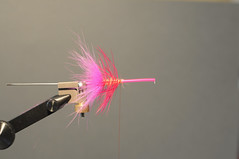
Tie in a long thin stemmed marabou feather and make 4-6 turns, picking out and combing back marabou with each turn.
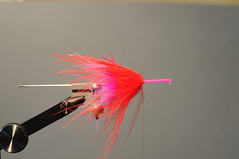
Take anywhere from 12-18 ostrich herls and clump them together. From here, wet them and then using a black sharpie color 6-8 bars to give the ostrich a barred look. Using 3-4 herls at a time tie them in and around the fly, evenly spreading out the herl.

Add some flash to the top of the fly. I prefer flashabou, krinkle flash, or krystal flash. All look good, another personal preference.
Tie in a golden pheasant tippet to create a collar. Schlappen can work as well but I really like the golden pheasant tippets because they are naturally barred and give the collar a unique look. Finish the head, burn the end of the tube and finished!

A few of the reasons the Crippler is so effective is the large profile created by the arctic fox and hackled schlappen. This allows the marabou to breath and keep a big profile in the current without collapsing. The other thing to notice is how the ass end of the fly with the dubbing ball/arctic fox glows in the light(see pic below).
 Rob Elam photo
Another pic of a big profile in the water...the sink test!

3.25.2010
2010 Winter Season comes to a close
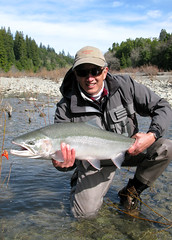
Our 2010 California Winter steelhead season has all but come to a close. While many of our rivers are still open till March 31st, fishing has slowed and very few bright fish are showing. It's hard to believe how fast our winter season went by. While we had some good fishing, this years water conditions made fishable days on some of my favorite rivers few and far between. If we could have had an extra 8-12 days of good weather during "prime time," I hate to think how many bright natives we could have hooked. That's winter steelheading though, we rarely get ideal conditions. The following are a few pics from the 09-10' winter season. More pics can be seen on the website in the next few days...


3.14.2010
Rio to Introduce M.O.W. tips later this spring
It has finally happened! With the help of Mike McCune, Scott O'Donnell, and Ed Ward, Rio is introducing unique sink tip system called the M.O.W. (McCune, O'Donnell, Ward). This is a tip system these guys developed over the years and guiding and fishing skagit lines and having to alter tips to meet their demands. I was fortunate enough to learn this tip system a number of years ago from Mike and have been fishing them for a couple of years now. The M.O.W systems consist of 2.5', 5', 7.5', 10', 12' sink tips and a 10' floating tip. For example, the 2.5' tip has 2.5' of T-11/14 integrated to a 7.5' section of floating line. 5' tip is equals lengths of T-11/14 and floating line. This was the 2.5', 5', 7.5', and 10' sink tips are all 10' in length helping to keep a more consistent anchor. This tip system is ideal for switch and spey rods in the 11'-13'9" range and will come in T-8, T-11, and T-14 varieties. Look for the T-11/14 systems to be available by early May and the T-8 by fall. All kits will retail for 149.95 with a leader wallet. These are a must for any two-hand angler.
For more info check out the link on speypages
For more info check out the link on speypages
Subscribe to:
Posts (Atom)


